Welding is one of the most critical parts of any structural steel, fabrication, industrial equipment, or construction project. A weld may look simple from the outside, but its quality can directly affect safety, durability, performance, and long-term reliability. For contractors, fabricators, steel erectors, and project managers, professional welding inspection is not just a technical step. It is an important part of protecting the project from costly deficiencies, delays, rework, and documentation gaps.
MazCAN Inspection provides welding inspection services for fabrication shops, construction sites, structural steel projects, bridge and infrastructure work, industrial equipment, modular construction, and maintenance projects. The goal is to help project teams verify weld quality before installation, during construction, or as part of a broader quality assurance program.
What Does Welding Inspection Include?
Professional welding inspection focuses on the observable condition of welded joints, the workmanship of the weld, dimensional requirements, weld placement, and related quality documentation. An inspector may review weld size, profile, alignment, visible discontinuities, and whether the weld locations match project drawings and specifications.
For structural and industrial projects, this type of inspection is especially important because welding errors may affect connection strength, assembly alignment, and the overall quality of the finished component. Welding inspection may also support compliance with relevant project requirements, including CSA W59, AWS D1.1, AWS D1.5, and other applicable standards depending on the scope of work.
The Role of Visual Inspection
Visual inspection is one of the most important foundations of welding quality control. It allows trained inspectors to identify visible concerns before additional testing or project progression. This can include weld appearance, profile irregularities, dimensional concerns, alignment issues, and visible surface discontinuities.
A strong visual inspection process can help detect problems early. This is valuable because it gives the project team the opportunity to correct issues before they become more expensive or difficult to resolve. In many projects, visual testing also works together with non-destructive testing methods to provide a clearer picture of weld and material condition.
How NDT Supports Welding Quality
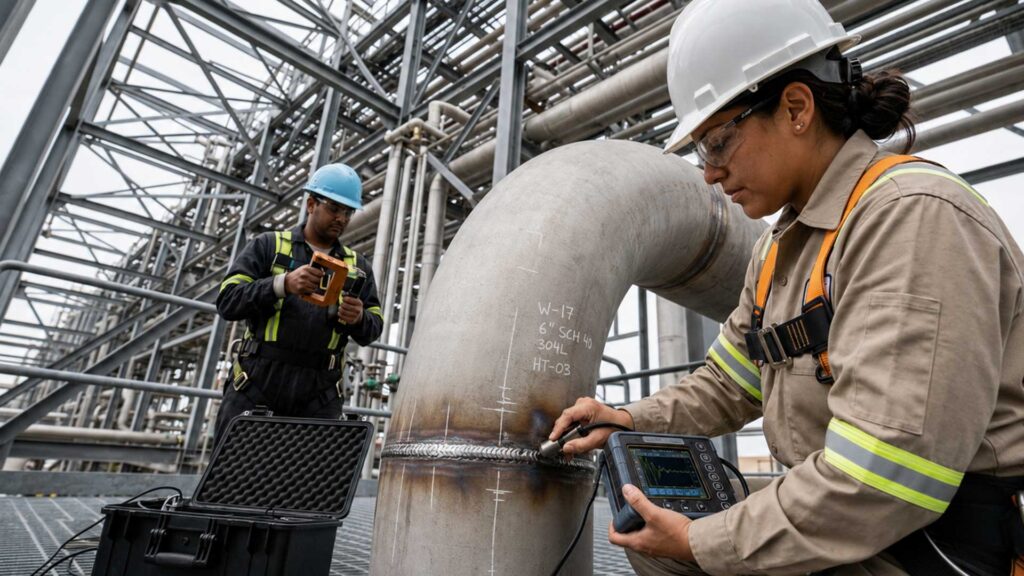
Non-Destructive Testing, commonly known as NDT, allows welds and materials to be examined without damaging the component. This is especially useful when the inspected asset must remain in service, continue through fabrication, or be evaluated without cutting, breaking, or removing material.
MazCAN Inspection’s NDT services include ultrasonic testing, magnetic particle testing, liquid penetrant testing, and visual testing. Each method has a different application. Ultrasonic Testing, UT, may be used for thickness measurement or internal discontinuity detection where conditions allow. Magnetic Particle Testing, MT, is valuable for detecting surface and near-surface discontinuities in ferromagnetic materials. Liquid Penetrant Testing, PT, is used to detect surface-breaking discontinuities in suitable non-porous materials. Visual Testing, VT, provides essential observations related to workmanship, alignment, and visible conditions.
By combining welding inspection with the right NDT method, project teams can make better decisions based on more complete inspection information.
Why Documentation Is Just as Important as Inspection
Inspection is only useful when the findings are clearly documented. Welding inspection reports help contractors, fabricators, and project managers understand what was observed, what requires attention, and how the inspection connects to drawings, specifications, or quality files.
Good documentation may include inspection observations, deficiency notes, weld inspection reporting, NDT result documentation, and drawing or specification references. This creates a record that supports communication between the contractor, fabrication team, quality manager, engineer, and owner.
Who Needs Welding Inspection Services?
Welding inspection is valuable for structural steel fabricators, general contractors, steel erectors, industrial equipment manufacturers, bridge and infrastructure projects, modular construction projects, and maintenance or repair teams. Any project involving critical welds, steel connections, fabricated assemblies, or quality documentation can benefit from professional inspection support.
Final Thoughts
Professional welding inspection helps protect project quality from the earliest stages of fabrication through final installation. By identifying visible concerns, reviewing workmanship, supporting NDT requirements, and preparing clear reports, MazCAN Inspection helps Ontario project teams maintain stronger control over welding quality and documentation.
For contractors and fabricators working with structural steel, industrial equipment, or critical welded components, inspection should not be treated as a last-minute step. It should be part of a disciplined quality process that supports safety, reliability, and better project outcomes.